Gift-giving has a recurring problem: most objects either duplicate something the recipient already owns or end up in a closet. Food avoids both traps. It gets used, it gets shared, and it disappears cleanly when it’s done.
French-inspired gourmet food is a particularly good version of this, because the category has range. It covers the savory and the sweet, the everyday and the special-occasion, the modest and the substantial. Here’s how to choose well.
Why Food Works as a Gift
Three reasons, mostly.
It’s consumable. Nothing lingers as an obligation. The recipient enjoys it and moves on, without the guilt of storing something they don’t want.
It’s shareable. A good box of food often becomes an evening with friends rather than a solitary treat, which effectively multiplies the gift.
It’s low-risk on preference. You don’t need to know someone’s taste in design, their size, or what’s already in their home. You need only a general sense of whether they like savory or sweet and whether they have dietary restrictions.
Matching the Gift to the Occasion
Birthdays. Personal gifts, so lean into what the person actually likes. Someone who cooks appreciates ingredients like good mustard, preserves, and specialty pantry items. Someone who entertains appreciates something they can put out for guests.
Holidays. Volume and presentation matter more. Holiday food gifts are often opened in front of others, and they frequently get shared immediately. Assortments do better than single items here.
Host gifts. The rule is: don’t create work. Something shelf-stable that the host can put away and open later is more considerate than something requiring immediate refrigeration during a party. Keep it modest in scale.
Thank-you gifts. These should feel warm but not extravagant, since an oversized gift can make the recipient feel indebted rather than appreciated. A well-chosen small assortment strikes the right note.
Corporate gifting. Neutrality and broad appeal are the priorities. Avoid alcohol unless you know the policy and the recipient. Favor items that can be shared around an office. Presentation carries more weight than usual because the gift represents an organization.
Choosing Based on the Recipient
Start with a simple question: does this person cook, or does this person eat?
Cooks want components: good oil, mustards, preserves, spices, specialty pantry staples. They enjoy the raw material and want to do something with it.
Non-cooks want things that are ready to enjoy. Charcuterie, pâté, cheese accompaniments, confections. Nothing requiring technique.
Then consider the household. A single person doesn’t want a gift built for eight; someone who entertains regularly appreciates board-ready items.
And confirm the obvious constraints: vegetarian, kosher, halal, gluten-free, nut allergies. Better an awkward question than an unusable gift.
Pâté and Charcuterie-Style Gifts
Savory French gifts have a real advantage: they’re immediately social. Pâté, terrines, rillettes, and cured meats aren’t things most people buy for themselves, which makes them feel genuinely like gifts rather than groceries.
Pâté in particular is worth understanding. It ranges from smooth, rich country-style preparations to coarser, more rustic terrines, and different versions suit different palates. For someone new to it, a milder, smoother preparation is the safer choice. For an adventurous eater, a more assertive terrine is more interesting.
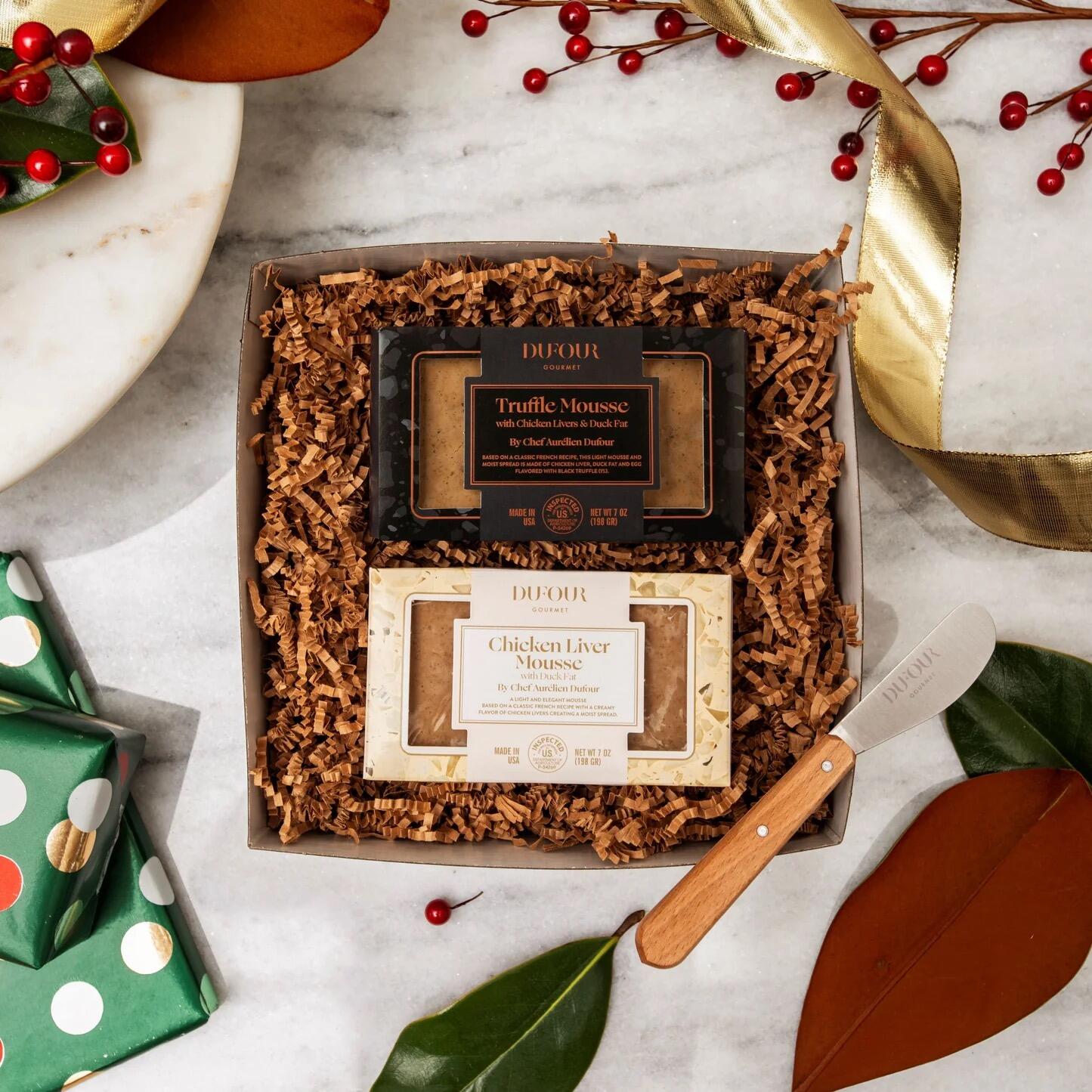
A curated pate gift set usually solves the selection problem by combining several styles with the accompaniments that make sense alongside them. That’s more useful than a single large item, because it gives the recipient variety and a reason to open it with company.
Charcuterie-style gifts work on the same logic. A selection of cured meats becomes a board, and a board becomes an evening.
Variety and Presentation
Variety is the single biggest factor in whether a food gift feels generous. Four modest items in different categories read as more thoughtful than one large item, because the recipient gets a small sequence of discoveries rather than a single note.
But there’s a limit. Twelve tiny jars of things feels scattered. Somewhere between three and six well-chosen items is the range where a gift feels considered rather than either sparse or random.
Presentation does real work. Food arriving in a proper box with sensible packaging communicates care in a way that a shipping carton of loose items doesn’t. This matters most for corporate gifts and holidays, and least for a casual gift to a close friend.
Pairings and Accompaniments
The best food gifts are complete. If you’re sending pâté, the recipient needs something to spread it on and something acidic alongside. If you’re sending cured meat, they need crackers or bread.
The standard accompaniments earn their place:
- Mustard. Grain or Dijon. Cuts richness and works with nearly every savory item.
- Crackers or crisps. Neutral is better than flavored.
- Preserves and fruit pastes. Fig jam, quince paste, and cherry preserves give sweetness against salt.
- Cornichons and pickles. Acidity to reset the palate.
- Honey. Works with cheese, charcuterie, and on its own.
A gift that includes its own accompaniments can be opened and enjoyed on the spot, which is a meaningfully better experience than one requiring a grocery run.
What to Look for in a Gourmet Gift
A few practical checks:
- Shelf life and storage. Know whether it needs refrigeration and how long it keeps. Say so in the note if it matters.
- Ingredient transparency. Clear labeling protects against allergy problems.
- Sensible packaging. Items should arrive intact and look intentional.
- Realistic portioning. Match the size to the household.
- Coherence. The items should relate to each other and suggest an occasion.
The Case for Curated Boxes
Curating a gift from scratch is satisfying if you know the recipient well and have the time. Most of the time, you have neither. Pre-assembled selections solve the coordination problem. Someone has already thought about how the items work together, sized the portions sensibly, and handled the packaging. Being able to browse gift boxes to send directly to a recipient also removes the logistics. There’s no shipping to yourself, repacking, and shipping again, which is where most well-intentioned food gifts fall apart.
For corporate gifting or holiday lists with multiple recipients, this is the only approach that scales. For a single close friend, a curated box plus one item you chose specifically for them is a good hybrid: the structure is handled, and the personal touch is still there.
Whatever you choose, include a note. The food is the gift, but the note is what gets remembered.