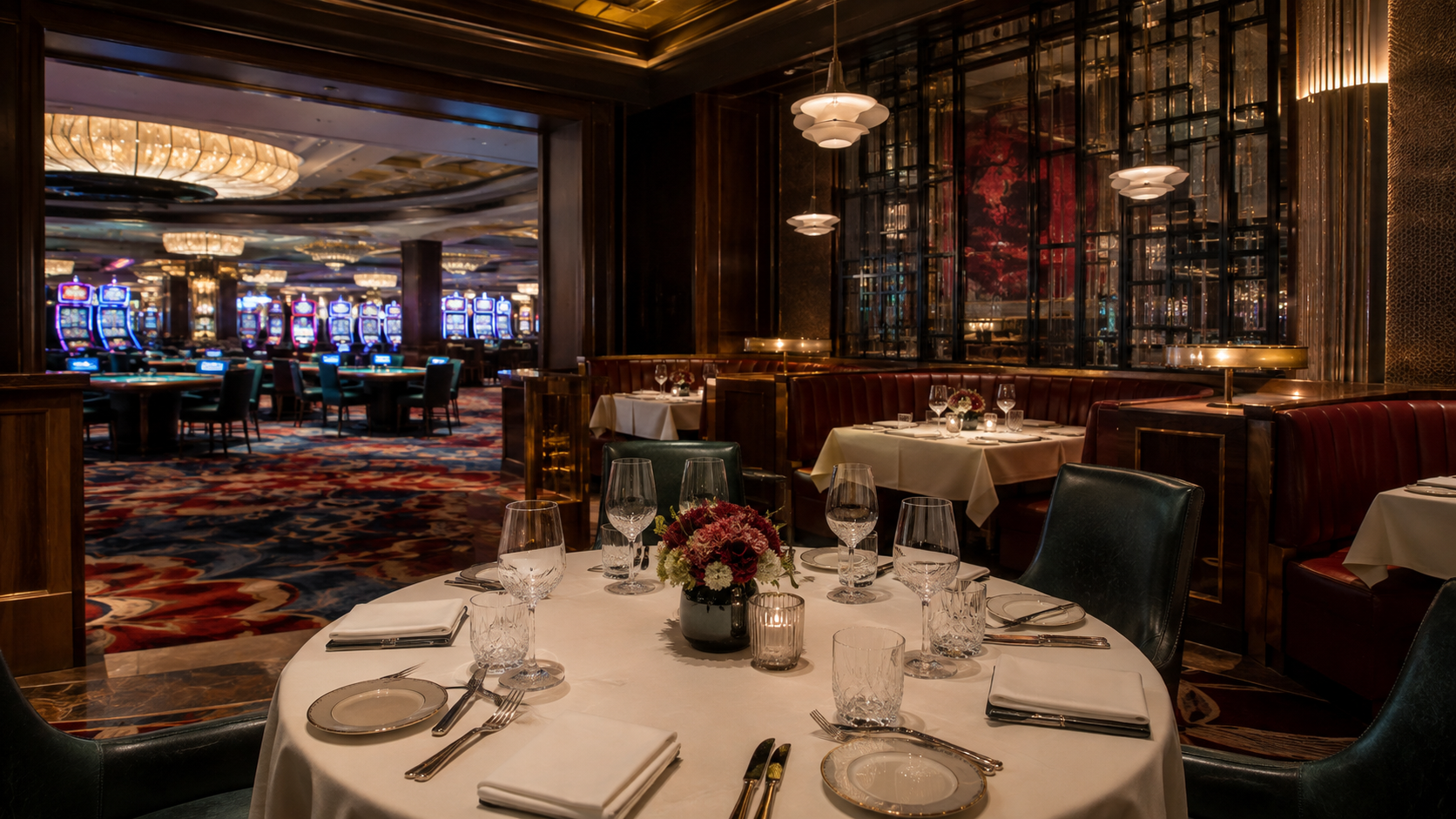
On 26 August a Strip resort hands its ballroom over to a tyre company. The first Michelin Guide Southwest ceremony lands in Las Vegas, the guide’s first proper look at the city since 2009, and plenty of the chefs waiting on the verdict cook inside buildings with a betting floor a lift ride away.
Four decades ago that pairing would have read as a category error, because the kitchen existed to keep a gambler fed and seated. If you’ve sat through a full Saturday card with a 1xbet login on site open in a second tab, you know the hunger that builds across ninety minutes of not much happening, and resorts have spent twenty years rebuilding their restaurants around that appetite.
The Buffet Was Always A Subsidy
Before 2020, by the count most people in the trade repeat, Las Vegas ran somewhere near 70 buffets. Prices bore no relation to what the food cost to produce, and nobody inside the building pretended otherwise. Back in 1984 gaming brought in 59% of all Strip revenue, so a carving station sold under cost was a sensible way to buy an afternoon of someone’s company. Replenishing forty trays takes a crew, and none of that waste ever showed up on a betting slip.
What Took The Buffet’s Place
That 59% has been sliding ever since, and fiscal 2025 marked the 27th year running in which the floor accounted for under half of what the Strip took. Rooms, dining, entertainment and retail now carry close to three quarters. Food halls moved into much of the vacated square footage, several branded counters sharing one dining room, a leaner kitchen behind them, and they’re priced to make money rather than to hold a crowd.
Where The Money Sits Now
Nevada publishes an unusually detailed set of casino accounts each year. The abstract covering the twelve months to 30 June 2025, released this June, put total revenue at the 51 Strip casinos clearing $1 million in gaming revenue at $21.1 billion, the second-highest figure recorded there. Gaming came to 26.1% of it, a line reported after $2.93 billion of complimentary expense comes off, so the floor reads smaller on paper than the money crossing it.
| Strip department, fiscal 2025 | Revenue |
| Rooms | $7.1 billion |
| Food | $3.99 billion |
| Beverage | $1.58 billion |
Food landed about $56 million short of the record set twelve months earlier, close enough to call it a plateau at a high altitude. Around $587 million of that is complimentary food booked at retail value, so the old subsidy hasn’t gone anywhere, it’s just itemised now.
Beverage takings slipped 3.2% while food stayed near flat, a gap worth chewing on if you’ve noticed how people pace a long afternoon in front of the screens. Across the state the shape repeats, gambling accounting for $11.2 billion of $30.8 billion in total revenue, kitchens and everything else carrying the other $19.6 billion.
Sport Changes How Visitors Spend
Visitor research from the local tourism authority gives the split from the other side. Of the 38.5 million people who came through last year, 81% gambled, up from 78%, and those who did set aside $849 for it across the trip. Food and drink took $583 a head, counting everyone. Sport showed up more often too, with 13% watching an event during their stay against 10% in 2024, though only 5% turned up to one in person.
Where The Sports Crowd Splits From The Rest
| Measure | Attended a sporting event | Everyone else |
| Food and drink per trip | $760 | $573 |
| Nights stayed | 3.5 | 3.2 |
| Bought a ticket before booking a room | 58% | 23% |
That’s one visitor in twenty, eating like a much larger share of the city. Timing explains some of it. Where a dinner service gets built around a 7pm rush, a fixture list runs to its own clock, stretching across the afternoon and into the night and pushing people out for something in the gap between one market settling and the next opening. Counters handle that better than a tasting room ever could.
Stars Change What A Kitchen Costs
Across the 2008 and 2009 editions, 17 restaurants here came away with stars, and only one ever reached three, the dining room carrying Joël Robuchon’s name. Michelin pointed at the economy when it paused the guide, then stayed away for 17 years without adding much to that. The new Southwest edition covers four states, with Bib Gourmand nods for good value alongside the stars, so the night won’t belong only to rooms charging several hundred dollars a head.
A star moves things. Reservation books tighten. Cooks who wouldn’t have applied start applying, and menu prices drift up behind the demand. Casino kitchens have run the reverse version of that arithmetic for half a century, back when the food was the draw and the betting floor did the earning. What a plaque on the wall does to the price of your table, inside a building where the betting floor never closes, gets its first test after 26 August.